Digital Marketing Ecosystem: Complete Guide, Channels & Strategy
Digital Marketing Ecosystem: A Complete Guide to How Online Marketing Works
Digital marketing is no longer about being present on Instagram, ranking on Google, or running paid advertisements individually. Modern businesses need a connected system where every digital channel contributes to a larger customer journey.
This connected system is known as the digital marketing ecosystem.A well-designed digital marketing ecosystem brings together SEO, content marketing, social media, paid advertising, email marketing, websites, analytics, CRM, automation, and other digital channels to attract the right audience, generate qualified traffic, nurture prospects, drive conversions, and build long-term customer relationships.
From an SEO perspective, the most important shift is this: SEO should not operate in isolation. Organic search can become significantly more valuable when it works alongside content, social media, paid campaigns, conversion optimization, analytics, and retention strategies.
In this guide, we will explore what a digital marketing ecosystem is, how its components work together, how SEO fits into the system, and how businesses can build an ecosystem that supports measurable growth.
What Is a Digital Marketing Ecosystem?
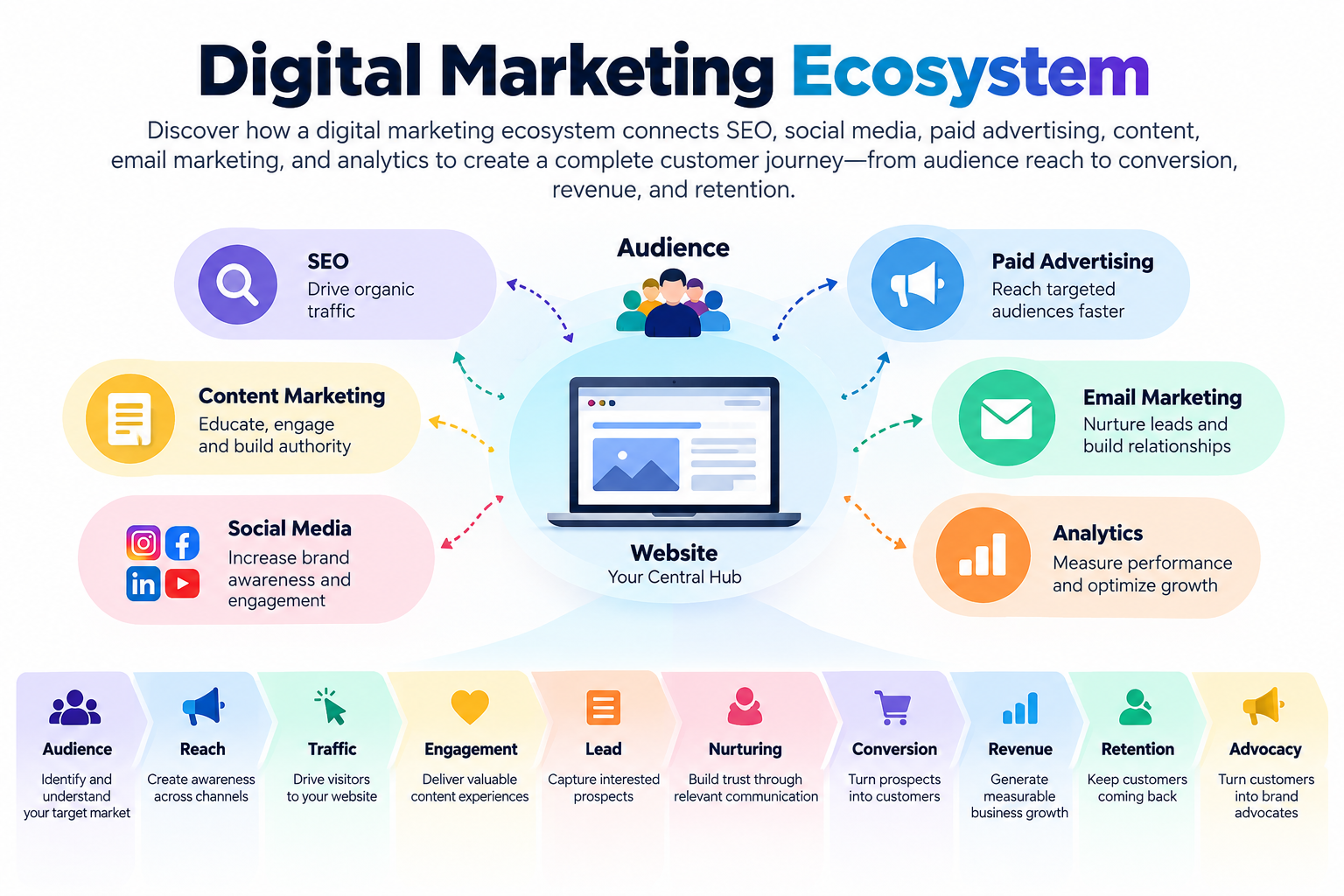
A digital marketing ecosystem is an interconnected network of digital channels, platforms, technologies, content, data, and marketing activities that work together to achieve business objectives.
Instead of treating each marketing channel as a separate activity, an ecosystem connects them around the customer journey.
For example:
Search → Website → Content → Lead Generation → Email/WhatsApp Nurturing → Conversion → Retention → Advocacy
Each stage has a different purpose, but the data and customer experience connect the entire journey.
Consider an education company promoting a digital marketing course.
A potential student may:
Search Google for "best digital marketing course."
Discover an SEO-optimized blog.
Visit the course website.
Watch an Instagram Reel.
See a remarketing advertisement.
Download a course brochure.
Receive an email or WhatsApp follow-up.
Book a counselling session.
Enroll in the course.
Later recommend the institute to another student.
No single channel necessarily created the entire conversion.
The ecosystem did.
Why Is a Digital Marketing Ecosystem Important?
Businesses today operate across multiple digital touchpoints. Customers rarely follow a perfectly linear path from advertisement to purchase.
They may discover a brand through social media, search for reviews on Google, visit the website, compare competitors, watch YouTube videos, read blogs, and return through a remarketing advertisement before finally purchasing.
A digital marketing ecosystem helps businesses manage this complexity.
1. Creates a Consistent Customer Journey
Every channel should communicate a consistent brand message.
Your:
Website
Instagram profile
Google search presence
Advertisements
Emails
Landing pages
Content
should feel like parts of the same brand experience.
2. Improves Marketing Efficiency
Instead of creating completely separate strategies for every channel, businesses can repurpose and distribute valuable content across multiple platforms.
For example, one comprehensive SEO article can become:
Instagram carousels
Reels
LinkedIn posts
YouTube Shorts
Email content
Pinterest content
This creates greater value from the original content investment.
3. Connects Marketing With Business Goals
Traffic alone is not the final objective.
A strong ecosystem connects:
Traffic → Leads → Customers → Revenue
This allows marketers to understand whether their activities are actually contributing to business growth.
4. Enables Better Data Collection
When channels are connected through analytics and CRM systems, businesses can understand:
Where users come from
What content they consume
Which pages convert
Which campaigns generate leads
Where users drop off
Which channels generate revenue
These insights improve future marketing decisions.
Key Components of a Digital Marketing Ecosystem
A digital marketing ecosystem consists of several interconnected components.
1. Search Engine Optimization (SEO)
SEO helps businesses become discoverable when potential customers actively search for information, products, or services.
A comprehensive SEO strategy includes:
Keyword research
Search intent analysis
Technical SEO
On-page optimization
Content strategy
Internal linking
Structured data
Digital PR and authority building
Local SEO
Performance monitoring
SEO is particularly valuable because it can capture high-intent organic demand.
For example, someone searching for:
"best digital marketing course in Ahmedabad"
has a different intent from someone scrolling through a general digital marketing post on Instagram.
Understanding this difference is critical for building the right content and conversion journey.
2. Content Marketing
Content is one of the central connecting layers of the digital marketing ecosystem.
Content can include:
Blog articles
Landing pages
Case studies
Videos
Reels
Infographics
E-books
Webinars
Guides
Email newsletters
Social media posts
The objective should not simply be to publish more content.
The objective is to create the right content for the right audience at the right stage of the customer journey.
For example:
Top of Funnel
"How does digital marketing work?"
Middle of Funnel
"SEO vs Google Ads: Which is better for businesses?"
Bottom of Funnel
"Best digital marketing agency in Ahmedabad"
Each query represents a different level of intent.
3. Social Media Marketing
Social media creates awareness, engagement, community, and brand familiarity.
Important platforms may include:
Instagram
Facebook
LinkedIn
YouTube
Pinterest
X
The right platform depends on the target audience and business model.
Social media can also support SEO indirectly by increasing content discovery, brand searches, engagement, and referral traffic.
For example, a business can publish a short educational Reel and direct interested users to a detailed blog.
This creates a connection between:
Social Discovery → Website Traffic → Content Consumption → Lead Generation
4. Paid Advertising
Paid advertising provides businesses with faster access to targeted audiences.
Common channels include:
Google Ads
Meta Ads
LinkedIn Ads
YouTube Ads
Display advertising
Remarketing campaigns
Paid campaigns can complement SEO rather than compete with it.
For example, SEO can build long-term organic visibility while paid search captures immediate demand for commercially valuable keywords.
Businesses can also use paid campaigns to test:
Headlines
Offers
Landing pages
Audience segments
Creative concepts
Keywords
The insights generated through paid campaigns can sometimes inform broader content and SEO strategies.
5. Email Marketing
Email marketing is particularly valuable for lead nurturing and retention.
A user who is not ready to purchase today may become a customer after receiving useful information over time.
A basic email journey could look like:
Lead Capture → Welcome Email → Educational Content → Case Study → Offer → Follow-Up → Conversion
Email allows businesses to communicate directly with users rather than relying entirely on rented platform audiences.
6. Influencer and Affiliate Marketing
Influencer marketing helps brands access established communities and build awareness through trusted creators.
Affiliate marketing, meanwhile, allows businesses to work with partners who earn a commission for generating sales or leads.
Both can become part of a broader acquisition strategy.
However, businesses should measure more than reach.
Important metrics include:
Qualified traffic
Leads
Conversion rate
Revenue
Customer acquisition cost
Return on investment
7. Website and Landing Pages
The website is often the central destination within the digital ecosystem.
It converts traffic from multiple sources into meaningful actions.
A high-performing website should provide:
Clear navigation
Strong value proposition
Search-friendly content
Fast performance
Mobile usability
Clear calls-to-action
Trust signals
Relevant landing pages
Easy conversion paths
Driving thousands of visitors to a poorly optimized website will not automatically generate business.
This is why SEO and conversion rate optimization must work together.
8. Analytics and Tracking
Analytics connects marketing activity with measurable outcomes.
Marketers should track metrics such as:
Organic sessions
Keyword visibility
Click-through rate
Engagement
Leads
Conversion rate
Cost per lead
Customer acquisition cost
Revenue
Return on ad spend
Customer lifetime value
The exact KPI framework depends on the business model.
A SaaS company, e-commerce brand, local business, and educational institute should not necessarily measure success in exactly the same way.
How Does the Digital Marketing Ecosystem Work?
A simple digital marketing ecosystem can be visualized as:
Audience → Awareness → Traffic → Engagement → Lead → Nurturing → Conversion → Revenue → Retention → Advocacy
Let's break it down.
Stage 1: Awareness
Users discover the brand through:
Search engines
Social media
Paid advertisements
Influencers
YouTube
Referrals
Stage 2: Traffic
Interested users visit:
Website
Blog
Product pages
Landing pages
Social profiles
Stage 3: Engagement
Users interact with the brand by:
Reading content
Watching videos
Downloading resources
Following social profiles
Comparing products
Subscribing to newsletters
Stage 4: Lead Generation
Businesses encourage users to take an action.
Examples:
Form submission
Consultation booking
Newsletter signup
Free trial
Brochure download
WhatsApp inquiry
Stage 5: Lead Nurturing
Not every lead is ready to purchase immediately.
Businesses can nurture prospects through:
Email
WhatsApp
Retargeting
Educational content
Case studies
Webinars
Stage 6: Conversion
The prospect becomes a customer.
Stage 7: Retention
Marketing continues after the purchase through:
Email campaigns
Loyalty programs
Customer support
Personalized offers
Educational content
Stage 8: Advocacy
Satisfied customers can become:
Reviewers
Repeat customers
Referrers
Brand advocates
This creates a powerful growth loop.
The Role of SEO in the Digital Marketing Ecosystem
From a Senior SEO Executive's perspective, SEO should be treated as more than a ranking activity.
The goal is not simply:
"Get the keyword to position #1."
The larger objective is:
Capture relevant demand → satisfy search intent → provide value → create engagement → generate conversions.
A mature SEO strategy should connect several areas.
Keyword Research
Keyword research identifies what the audience is actually searching for.
But modern keyword research should go beyond search volume.
SEO professionals should evaluate:
Search intent
Competition
Business relevance
SERP features
Commercial value
Conversion potential
Topic relationships
A keyword with lower search volume but strong commercial intent may be more valuable than a high-volume informational keyword.
Search Intent and Content Strategy
Search intent can generally be categorized into:
Informational
The user wants information.
Example:
"What is digital marketing?"
Navigational
The user is looking for a specific website or brand.
Example:
"Frameboxx website"
Commercial Investigation
The user is researching options.
Example:
"Best digital marketing courses in Ahmedabad"
Transactional
The user is ready to take action.
Example:
"Join digital marketing course Ahmedabad"
Content should be created according to the intent behind the query.
Technical SEO
Technical SEO ensures that search engines can efficiently discover, crawl, understand, and index a website.
Key areas include:
Crawlability
Indexation
Site architecture
XML sitemaps
Robots.txt
Canonicalization
Page speed
Core Web Vitals
Mobile usability
HTTPS
Structured data
JavaScript SEO
Technical SEO creates the foundation upon which content and authority strategies operate.
On-Page SEO
On-page SEO focuses on making individual pages useful and understandable for both users and search engines.
Important elements include:
Title tags
Meta descriptions
Headings
URL structure
Content quality
Keyword relevance
Internal links
Image optimization
Schema markup where appropriate
However, optimization should never result in unnatural keyword stuffing.
The priority should be helpful content that satisfies the user's intent.
Internal Linking and Topic Authority
Internal linking connects related pages and helps users navigate the website.
For example:
Digital Marketing Guide
could link to:
SEO Guide
Social Media Marketing Guide
Content Marketing Guide
Paid Advertising Guide
Email Marketing Guide
Marketing Funnel Guide
This creates a logical topic structure and helps search engines understand relationships between pages.
How SEO Works With Other Marketing Channels
The real strength of SEO appears when it integrates with other channels.
SEO + Social Media
A blog can generate the foundation for multiple social media posts.
Blog → Carousel → Reel → LinkedIn Post → Newsletter
Social distribution can increase content discovery and brand visibility.
SEO + Paid Ads
SEO provides long-term organic visibility while paid advertising provides immediate visibility.
Businesses can use both strategies to capture demand at different stages.
SEO + Email Marketing
SEO can attract new users, while email can nurture them after lead capture.
Organic Search → Blog → Lead Magnet → Email Sequence → Conversion
SEO + Remarketing
A visitor who reads a product page but does not convert can later receive a relevant remarketing advertisement.
This connects organic acquisition with paid conversion strategies.
Digital Marketing Funnel
The ecosystem can also be mapped to the marketing funnel.
TOFU — Top of Funnel
Objective: Awareness
Channels:
SEO
Social media
YouTube
Influencer marketing
Display advertising
Content:
Educational blogs
Reels
Guides
Videos
Infographics
MOFU — Middle of Funnel
Objective: Consideration
Channels:
SEO
Email
Remarketing
Webinars
Social media
Content:
Comparisons
Case studies
Product guides
Reviews
Webinars
BOFU — Bottom of Funnel
Objective: Conversion
Channels:
Paid search
Remarketing
Email
Landing pages
Sales outreach
Content:
Product pages
Pricing pages
Testimonials
Offers
Demonstrations
Consultation pages
Example: Digital Marketing Ecosystem for a Jewellery Brand
Consider a jewellery brand selling anti-tarnish jewellery online.
The ecosystem could look like this:
Awareness
Instagram Reels + Meta Ads + Influencer Marketing
↓
Discovery
Google Search + SEO Blogs
↓
Website
Product pages + Category pages + Buying guides
↓
Lead Generation
Discount popup + WhatsApp + Email signup
↓
Nurturing
Email + WhatsApp + Remarketing
↓
Conversion
Product page + Offer + Checkout
↓
Retention
Post-purchase email + Jewellery care content + Loyalty offer
↓
Advocacy
Reviews + UGC + Referral program
Now every channel has a specific role.
That is the difference between digital marketing activities and a digital marketing ecosystem.
KPIs for Measuring a Digital Marketing Ecosystem
A strong measurement framework should connect channel-level metrics with business outcomes.
Objective | Key KPIs |
|---|---|
Awareness | Reach, impressions, brand searches |
SEO | Organic traffic, rankings, CTR, visibility |
Engagement | Engagement rate, time on page, video views |
Lead Generation | Leads, conversion rate, CPL |
Sales | Revenue, transactions, conversion rate |
Paid Advertising | CPC, CPA, ROAS |
Retention | Repeat purchases, retention rate |
Customer Value | CLV, average order value |
Overall Growth | CAC, revenue, ROI |
One important principle is:
Do not optimize only for traffic. Optimize for business value.
A website can increase organic traffic by 100% while generating little additional revenue if the traffic is irrelevant.
Common Digital Marketing Ecosystem Mistakes
1. Treating Every Channel Separately
SEO, social media, paid ads, and email should not operate as completely independent departments.
2. Focusing Only on Vanity Metrics
Likes, followers, impressions, and traffic can be useful indicators, but they do not automatically equal revenue.
3. Ignoring Search Intent
Creating content around keywords without understanding user intent often produces low-quality traffic.
4. Publishing Content Without a Conversion Path
A blog should have a logical next step when appropriate.
For example:
Blog → Related Resource → Lead Form → Nurturing → Conversion
5. Poor Tracking
Without accurate analytics and conversion tracking, marketers cannot confidently identify what is driving growth.
6. Ignoring Retention
Acquiring a customer is only one part of the journey.
Retention and repeat purchases can significantly influence long-term profitability.
How to Build a Digital Marketing Ecosystem
Businesses can build their ecosystem using the following framework.
Step 1: Define Business Objectives
Start with the business goal.
Examples:
Increase sales
Generate qualified leads
Increase store visits
Build brand awareness
Improve customer retention
Step 2: Understand the Audience
Define:
Demographics
Pain points
Needs
Search behavior
Buying motivations
Objections
Preferred platforms
Step 3: Map the Customer Journey
Identify what happens from:
First Discovery → Research → Consideration → Purchase → Retention
Step 4: Select Appropriate Channels
Do not use every available platform.
Select channels based on:
Audience behavior
Business model
Resources
Budget
Expected return
Step 5: Build the Content Strategy
Create content around:
Search demand
Customer questions
Pain points
Product/service benefits
Commercial opportunities
Step 6: Create Conversion Paths
Every major traffic source should have a relevant next step.
Step 7: Implement Tracking
Set up analytics, conversion tracking, CRM integration, and reporting.
Step 8: Measure and Optimize
Analyze performance regularly and improve:
Content
Landing pages
Campaigns
Keywords
Audiences
Offers
Conversion paths
A digital marketing ecosystem is not something a business builds once and forgets.
It is a continuous optimization system.
The Future of the Digital Marketing Ecosystem
The digital marketing ecosystem is becoming increasingly interconnected.
Artificial intelligence is changing how marketers approach:
Content research
Keyword analysis
Personalization
Automation
Customer segmentation
Predictive analytics
Creative development
Search is also evolving. Users increasingly interact with search engines through conversational queries, AI-powered interfaces, visual search, and other discovery experiences.
This means SEO professionals need to think beyond traditional rankings.
The future of SEO is increasingly about being discoverable, useful, credible, and present across the complete search and customer journey.
First-party data will also become increasingly important as businesses focus on building direct relationships with customers rather than depending entirely on third-party platforms.
Final Thoughts
A successful digital marketing strategy is not simply a collection of SEO campaigns, social media posts, advertisements, and emails.
It is an interconnected ecosystem.
SEO can attract high-intent users. Content can educate them. Social media can build familiarity. Paid advertising can accelerate reach. Email can nurture prospects. Websites and landing pages can convert them. Analytics can reveal what is working. CRM and retention strategies can turn one-time customers into long-term relationships.
The strongest digital marketing ecosystems therefore follow one fundamental principle:
Every channel should have a purpose, every interaction should contribute to the customer journey, and every activity should ultimately connect to a measurable business outcome.
When these elements work together, digital marketing stops being a collection of individual tactics and becomes a scalable growth system.
Frequently Asked Questions
What is a digital marketing ecosystem?
A digital marketing ecosystem is a connected system of digital channels, technologies, content, data, and strategies that work together to attract audiences, generate traffic, nurture prospects, drive conversions, and retain customers.
What are the main components of a digital marketing ecosystem?
The major components include SEO, content marketing, social media, paid advertising, email marketing, influencer marketing, affiliate marketing, websites, landing pages, analytics, CRM, and marketing automation.
Why is SEO important in a digital marketing ecosystem?
SEO helps businesses capture relevant organic search demand. When integrated with content, social media, paid advertising, email, and conversion optimization, SEO can contribute to the complete customer journey rather than simply generating website traffic.
Is social media part of the digital marketing ecosystem?
Yes. Social media contributes to awareness, engagement, community building, content distribution, traffic generation, and customer relationships.
How do you measure a digital marketing ecosystem?
Measurement should combine channel-specific KPIs with business outcomes. Common metrics include organic traffic, CTR, leads, conversion rate, CPL, CAC, ROAS, revenue, retention, and customer lifetime value.