Meta Ads vs. Google Ads: Which Is Better for Your Business?
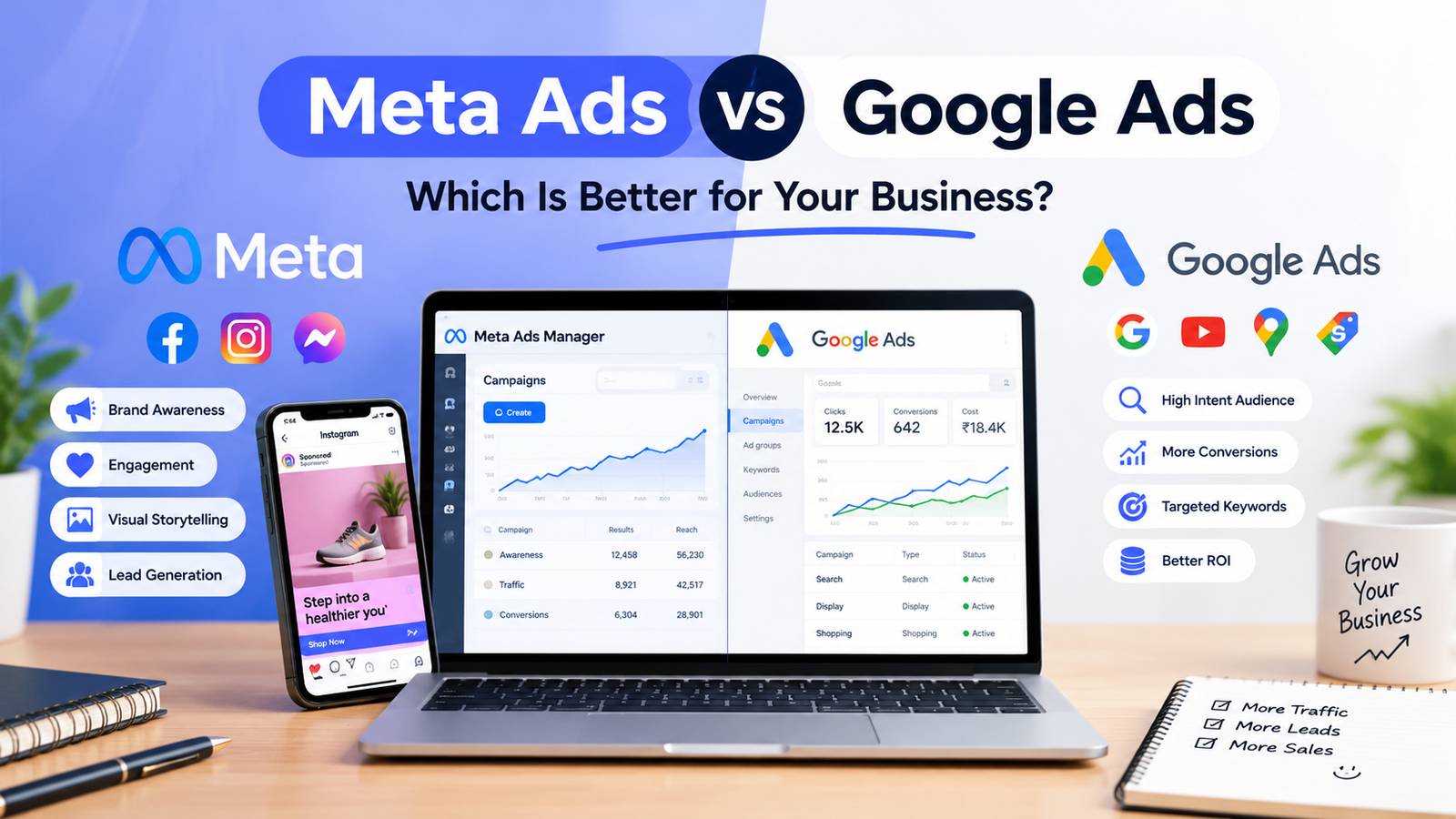
Meta Ads vs. Google Ads: Which Is Better for Your Business?
Meta Ads or Google Ads—which one should you choose to grow your business? Both platforms help businesses reach potential customers, generate leads, and increase sales. But they work in different ways. Discover their key differences, benefits, costs, and how to choose the right advertising platform for your business.
Introduction: The Big Question Every Business Owner Asks
Imagine you own a business and want to attract more customers online. You have a limited advertising budget, so you want to invest your money wisely.
You start exploring online advertising and discover two popular options: Meta Ads and Google Ads.
Now comes the big question: Which platform will give you better results?
The answer depends on your business goals, target audience, products or services, and marketing strategy.
Meta Ads can help you introduce your brand to people who may be interested in your products. Google Ads can help you connect with people who are actively searching for products or services like yours.
In this blog, we will explain the difference between Meta Ads and Google Ads in simple language, compare their advantages, explore practical examples, and help you decide which platform is right for your business.
What Are Meta Ads?
Meta Ads are paid advertisements that businesses run through Meta Ads: Start advertising on Facebook, Instagram, Messenger and WhatsApp | Meta for Business Meta's advertising platform. These ads can appear on Facebook, Instagram, Messenger, and other eligible placements.
Meta Ads are particularly useful for visual storytelling, building brand awareness, promoting products, and connecting with relevant audiences.
Businesses can use images, videos, Reels, Stories, carousel ads, and other creative formats to capture attention.
Key Benefits of Meta Ads
1. Reach your target audience
Meta Ads offer audience-targeting options based on available demographic, interest, behavioural, and interaction signals.
2. Promote products visually
Businesses can use attractive images and videos to demonstrate products, showcase benefits, and communicate their brand personality.
3. Build brand awareness
Your advertisements can introduce your business to people who have not discovered your brand yet.
4. Generate leads and enquiries
Depending on the campaign setup, you can encourage people to fill out forms, visit your website, start a conversation, or make a purchase.
5. Retarget interested audiences
With eligible audiences and appropriate tracking, you can reconnect with people who have previously interacted with your business.
Example of Meta Ads
Imagine you own a beauty salon. You want more people to discover your services and book appointments.
You create an Instagram Reel showing a hair transformation, add an attractive offer, and run a Meta Ads campaign targeting a relevant local audience.
People discover your salon while scrolling through Instagram, watch your video, and may decide to book an appointment.
The key idea: Meta Ads can help create interest in your business, even when people are not actively searching for your services.
What Are Google Ads?
Google Ads is Google's online advertising platform. It allows businesses to advertise through Google Search and other eligible channels, depending on the campaign type. For more information visit https://business.google.com/in/google-ads
One of its major advantages is the ability to reach people who are actively looking for specific products, services, or information.
For example, when someone searches for "best digital marketing course near me," relevant Google Search ads may appear alongside organic search results.
Key Benefits of Google Ads
1. Reach people with purchase intent
Search advertising can connect your business with people who are already looking for a solution.
2. Target relevant keywords
You can choose relevant keywords and configure targeting to reach people searching for products or services related to your business.
3. Generate leads and sales
Google Ads can direct potential customers to landing pages where they can enquire, book an appointment, or purchase a product.
4. Measure campaign performance
You can track important metrics such as clicks, advertising costs, and conversions when measurement is configured correctly.
5. Choose from different campaign formats
Depending on your objectives, you can explore Search, Display, Shopping, Video, and other campaign types.
Example of Google Ads
Imagine you own a digital marketing institute. A student searches Google for "digital marketing course in Ahmedabad."
If your campaign targets relevant searches and your advertisement meets the platform's requirements, your ad may appear to that student.
The student clicks the advertisement, visits your course page, reviews the details, and submits an enquiry form.
The key idea: Google Search Ads can help your business reach people who are already looking for what you offer.
Meta Ads vs. Google Ads: What's the Difference?
Although both platforms help businesses advertise online, their strengths are different.
Comparison | Meta Ads | Google Ads |
|---|---|---|
Main purpose | Build interest and discover new audiences | Capture demand and reach people searching |
Popular platforms | Facebook and Instagram | Google Search, YouTube, and other eligible placements |
Audience approach | Audience signals, interests, demographics, and interactions | Search intent, keywords, and campaign-specific targeting |
Creative formats | Images, videos, Reels, Stories, carousels | Search text ads, video ads, Display ads, Shopping ads |
Strong use case | Product discovery and brand awareness | Search-driven enquiries and sales |
Example | Showing a fashion ad while someone scrolls Instagram | Showing an ad when someone searches for a fashion product |
Important metrics | Reach, engagement, leads, conversions, cost per result | Clicks, CTR, CPC, conversions, cost per conversion |
Neither platform is automatically better for every business. Your results depend on your offer, competition, creative quality, audience, landing page, and campaign optimization.
Meta Ads vs. Google Ads: Which Is More Affordable?
Advertising cost is one of the most common concerns for businesses.
However, there is no fixed rule that Meta Ads are always cheaper or Google Ads are always more expensive. Costs vary by industry, audience, competition, campaign objective, and location.
Meta Ads Costs
Meta Ads may be useful for testing creative ideas and reaching audiences with different interests. Your costs will depend on competition, ad quality, campaign objectives, and the results you want.
Google Ads Costs
Google Search Ads can become competitive when many businesses bid on the same keywords. The cost also depends on factors such as keyword competition, ad relevance, and campaign settings.
How should you compare costs?
Do not compare platforms using clicks alone. Compare the cost of achieving your actual business goal.
For example, a campaign generating inexpensive clicks but no enquiries may be less useful than a campaign generating fewer clicks and more qualified leads.
Track your cost per lead, conversion rate, customer acquisition cost, and return on ad spend wherever relevant.
Which Platform Is Better for Different Businesses?
The right platform depends on how your customers discover and purchase your products or services.
1. E-commerce Businesses
Potential fit: Meta Ads and Google Ads
Meta Ads can showcase products through engaging visual content. Google Shopping and Search campaigns can help connect products with people searching for them.
A combined approach may work well when your budget and tracking setup support it.
2. Local Businesses
Potential fit: Google Search Ads, supported by Meta Ads
A plumber, dentist, salon, or repair service may benefit from reaching people searching for a service in their area.
Meta Ads can also help promote offers and introduce local customers to the business.
3. Fashion and Beauty Brands
Potential fit: Meta Ads
Fashion and beauty products often benefit from visual content. Reels, product demonstrations, and creative advertisements can help introduce new products and encourage discovery.
Google Ads may also be valuable when customers search for specific products or brands.
4. Educational Institutes
Potential fit: Both platforms
Google Search Ads can help reach students searching for courses, while Meta Ads can introduce programmes, showcase student experiences, and generate enquiries.
5. B2B and Professional Services
Potential fit: Google Search Ads, with Meta Ads as a supporting channel
Businesses offering consulting, software, or specialized services may use Google Search Ads to reach people looking for solutions. Meta Ads can support awareness and eligible remarketing campaigns.
These are starting points, not fixed rules. Test your approach using real campaign data.
Can You Run Meta Ads and Google Ads Together?
Absolutely! Instead of treating these platforms as competitors, businesses can use them to support different stages of the customer journey.
Here is a simple example:
Step 1: Create awareness with Meta Ads
Introduce your product to a relevant audience using engaging videos or images.
Step 2: Build interest
Share useful content, product benefits, customer experiences, and answers to common questions.
Step 3: Capture search demand with Google Ads
Reach people searching for your product, service, or brand through relevant campaigns.
Step 4: Measure conversions
Track enquiries, purchases, and other meaningful actions using appropriate analytics and conversion tracking.
Step 5: Optimize your campaigns
Review results, improve advertisements, test landing pages, and allocate budget based on performance.
Keep in mind that customers may discover your brand on one platform and convert through another. Attribution and tracking limitations can make the customer journey more complex than a simple five-step funnel.
Important Digital Marketing Metrics You Should Track
Running advertisements is only one part of the process. Understanding performance is what helps you improve.
Here are six important metrics to know:
1. CTR (Click-Through Rate)
The percentage of ad impressions that result in clicks.
2. CPC (Cost Per Click)
The average amount paid for each click.
3. CPM (Cost Per Thousand Impressions)
The cost of receiving 1,000 ad impressions.
4. Conversion Rate
The percentage of relevant visits or interactions that result in a desired action.
5. CPA (Cost Per Acquisition)
The average advertising cost per defined acquisition or conversion.
6. ROAS (Return on Ad Spend)
The revenue attributed to advertising divided by the advertising spend.
For example, suppose you spend ₹5,000 on ads and generate ₹20,000 in attributed revenue.
ROAS = ₹20,000 ÷ ₹5,000 = 4x
This means the campaign generated ₹4 in attributed revenue for every ₹1 spent on advertising. It does not mean the business earned ₹4 in profit, because product costs and other expenses still need to be considered.
Common Mistakes to Avoid When Running Ads
Even a well-funded advertising campaign can perform poorly when the strategy is weak.
Avoid these common mistakes:
Targeting everyone: Define an audience that is relevant to your offer.
Using weak creatives: Make your advertisement clear, engaging, and relevant.
Ignoring landing pages: Ensure the destination page matches the advertisement and makes the next step easy.
Focusing only on likes and clicks: Track leads, sales, and other meaningful outcomes.
Not testing different approaches: Experiment with creative formats, messages, keywords, and landing pages.
Ignoring conversion tracking: Configure measurement so you can understand which campaigns are delivering results.
Increasing budgets too quickly: Evaluate performance and make changes based on sufficient data.
Remember, successful digital advertising requires a clear strategy, consistent measurement, and ongoing improvement.
Final Verdict: Meta Ads or Google Ads?
So, which is better for your business?
The answer is simple: Choose the platform that matches your customer's behaviors and your business goal.
Choose Meta Ads when you want to build awareness, showcase products, and introduce your brand to relevant audiences.
Choose Google Search Ads when you want to reach people actively searching for the products or services you offer.
Consider using both when you want to combine brand discovery with search-driven demand and have the budget to measure each channel properly.
Before investing, define your goal, understand your audience, choose suitable keywords or creatives, and establish a reliable way to measure results.
The best advertising strategy is not the one that generates the most clicks. It is the one that helps your business achieve meaningful, measurable results.
Ready to Grow Your Business with Digital Advertising?
Start by identifying your business goal: brand awareness, website traffic, qualified leads, or sales. Then choose your platform, test your campaign, and optimize based on the results.
Your next customer could be one well-planned campaign away.
Frequently Asked Questions (FAQs)
1. What is the main difference between Meta Ads and Google Ads?
Meta Ads are often used to introduce products and build interest among relevant audiences. Google Search Ads are especially useful for reaching people who are actively searching for specific products or services.
2. Are Meta Ads cheaper than Google Ads?
Not always. Advertising costs depend on competition, audience, industry, campaign objective, and conversion quality. Compare cost per meaningful result instead of assuming one platform is always cheaper.
3. Which is better for small businesses: Meta Ads or Google Ads?
Both can work for small businesses. Meta Ads may suit businesses that benefit from visual content and audience discovery, while Google Search Ads may suit businesses whose customers actively search for their services.
4. Can beginners run Meta Ads and Google Ads?
Yes. Beginners can learn both platforms by starting with a clear objective, a realistic budget, accurate conversion tracking, and a well-defined target audience.
5. Which platform is better for generating leads?
It depends on the business. Google Search Ads can capture existing demand, while Meta Ads can create interest and generate leads through suitable campaign formats. Compare lead quality and the cost of acquiring qualified leads.
6. Can I use Meta Ads and Google Ads at the same time?
Yes. They can support different stages of the customer journey. Make sure your campaigns have clear roles, appropriate tracking, and realistic budgets.
7. What is a good advertising budget for beginners?
There is no universal starting budget. Choose an amount your business can afford to test, consider your industry and expected conversion costs, and make sure you can gather useful performance data before scaling.
8. How long does it take to see results from paid advertising?
Some campaigns can generate clicks or enquiries soon after launch, but reliable optimization takes time. Results depend on the offer, competition, tracking, landing page, budget, and audience. Evaluate meaningful outcomes rather than relying on a fixed timeline.