AI in SEO 2027: How AI Is Changing Search and Content Strategy
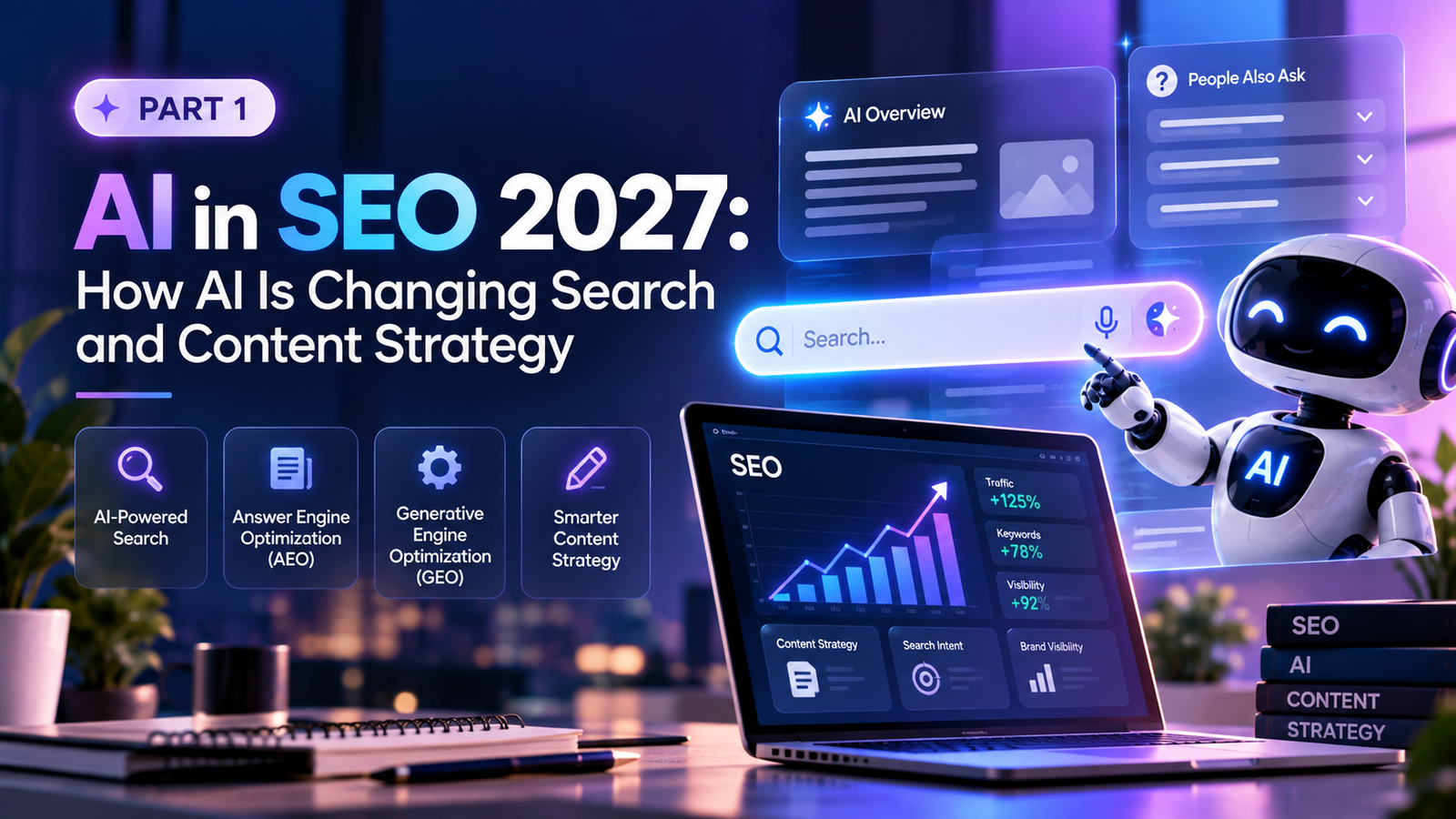
AI in SEO 2027: How AI Is Changing Search and Content Strategy
Introduction
Artificial Intelligence (AI) is transforming how people search for information, discover businesses, and make purchasing decisions. Traditional SEO focuses on keyword research, website optimization, backlinks, and organic rankings. However, AI-powered search experiences are changing how users find and consume information.
Today, users can ask complex questions and receive summarized answers through AI-powered search tools. This means businesses must think beyond traditional rankings and focus on providing useful information, building brand credibility, and understanding search intent.
As we approach 2027, the important question for digital marketers is no longer just how to rank a website, but how to make a brand discoverable across evolving search experiences.
Let's explore the key developments shaping AI and SEO.
1. AI-Powered Search Is Changing User Behaviour
Traditional search usually requires users to enter keywords, review results, and visit different websites to find information. AI-powered search allows users to ask detailed questions and receive summarized answers, sometimes with links to supporting sources.
For example, a user might search for “digital marketing courses in Ahmedabad.” With conversational search, they might ask, “Which digital marketing course is suitable for beginners who want to specialize in SEO?”
This shift encourages businesses to create content that directly addresses customer needs rather than focusing only on individual keywords.
What SEO professionals should do:
Understand the questions their target audience asks.
Create content for informational, commercial, and transactional search intent.
Provide clear answers supported by useful details.
Keep website content accurate and updated.
AI-powered search does not make traditional SEO irrelevant. Technical accessibility, useful content, and established SEO practices remain important foundations.
2. Answer Engine Optimization (AEO)
Answer Engine Optimization (AEO) focuses on making content useful for search experiences that provide direct answers to user questions.
For example, a digital marketing agency could publish an article answering, “How much does SEO cost for a small business?”
Instead of simply repeating the keyword, the article should explain the factors affecting SEO costs, the services involved, and what businesses should consider before hiring an agency.
To improve answer-focused content:
Use clear headings and descriptive subheadings.
Answer the main question directly.
Include relevant examples and reliable information.
Organize information into readable paragraphs and lists.
Make important content accessible to search engines.
AEO complements traditional SEO by emphasizing clarity and usefulness. However, there is no guaranteed content format that ensures inclusion in an AI-generated answer.
3. Generative Engine Optimization (GEO) and Brand Visibility
Generative Engine Optimization (GEO) refers to strategies intended to improve a brand's visibility in responses generated by AI systems.
AI assistants may summarize information from different sources when answering a question. This creates opportunities for businesses to establish expertise and become more discoverable.
Consider a jewellery brand that publishes helpful guides about jewellery materials, plating, product care, and choosing jewellery for different occasions. Such content can help customers make informed decisions while demonstrating the brand's knowledge.
Businesses can strengthen their online presence by:
Publishing original insights and research.
Maintaining accurate business information.
Earning relevant backlinks and credible industry mentions.
Creating useful resources that demonstrate expertise.
Monitoring how AI tools describe their brand.
GEO is an evolving practice, and different AI platforms may select and cite information differently. Marketers should experiment and evaluate results rather than assume that any single technique guarantees visibility.
4. AI Content Creation: Quality Over Quantity
AI writing tools can help marketers research topics, generate outlines, organize information, and improve readability. However, publishing large quantities of generic AI-generated content is not a reliable way to achieve SEO success.
Search engines aim to provide useful and relevant information. Content that adds little original value may fail to satisfy readers, regardless of how quickly it was produced.
Consider two approaches to writing about keyword research.
The first produces a generic article explaining what keywords are. The second combines AI assistance with actual keyword data, competitor research, search intent analysis, and practical examples.
The second approach gives readers more specific and actionable information.
Best practices for AI-assisted content:
Verify facts and statistics before publishing.
Include original analysis and practical examples.
Add relevant expertise and human review.
Avoid repetitive articles created only to target keywords.
Update outdated information when necessary.
AI should support content creation, not replace strategic thinking or factual responsibility. The objective is to publish content that genuinely helps users.
5. Understanding Search Intent in an AI-Driven World
Search intent is the reason behind a user's search query. Understanding it helps SEO professionals create content that matches what users actually need.
Search intent generally falls into four categories:
Intent | Example search | Suitable content |
|---|---|---|
Informational | What is SEO? | Educational blog |
Navigational | Google Search Console login | Official login page |
Commercial | Best SEO tools for beginners | Comparison article |
Transactional | Hire an SEO agency | Service or enquiry page |
AI-powered search can make queries more conversational, but understanding the user's objective remains essential.
For example, someone searching for “how to improve website rankings” needs guidance, while someone searching for “SEO agency pricing” is likely comparing service providers.
Businesses should map content to each stage of the customer journey. This helps attract relevant visitors, answer their questions, and guide them towards the next step.
Conclusion: The First Step Towards Future-Ready SEO
AI is changing how users discover information and how brands can become visible across search experiences. AI-powered search, AEO, GEO, and AI-assisted content creation are important developments for digital marketers to understand as 2027 approaches.
However, success does not depend on chasing every new trend. Businesses still need useful content, technically accessible websites, relevant information, and a clear understanding of their audience.
The most effective approach is to combine established SEO fundamentals with responsible AI adoption.
In Part 2, we will explore technical SEO, AI automation tools, SEO analytics, brand authority, and the practical strategies businesses can use to prepare for SEO in 2027.
Frequently Asked Questions
1. What is AI in SEO?
AI in SEO involves using artificial intelligence to support activities such as keyword research, content planning, search analysis, optimization, and performance reporting.
2. What is the difference between AEO and GEO?
AEO focuses on making content useful for answer-oriented search experiences, while GEO focuses on visibility within generative AI responses. Both complement traditional SEO.
3. Can AI-generated content rank on Google?
AI-assisted content can appear in search results when it provides value and complies with applicable search policies. Producing large amounts of unhelpful content through automation can violate Google's spam policies.
4. How can businesses improve their visibility in AI search?
Businesses should create accurate, useful content, maintain technically accessible websites, demonstrate expertise, build credible online references, and monitor their visibility across relevant platforms.