AI in SEO 2027: Strategies, Tools, and the Future of Search
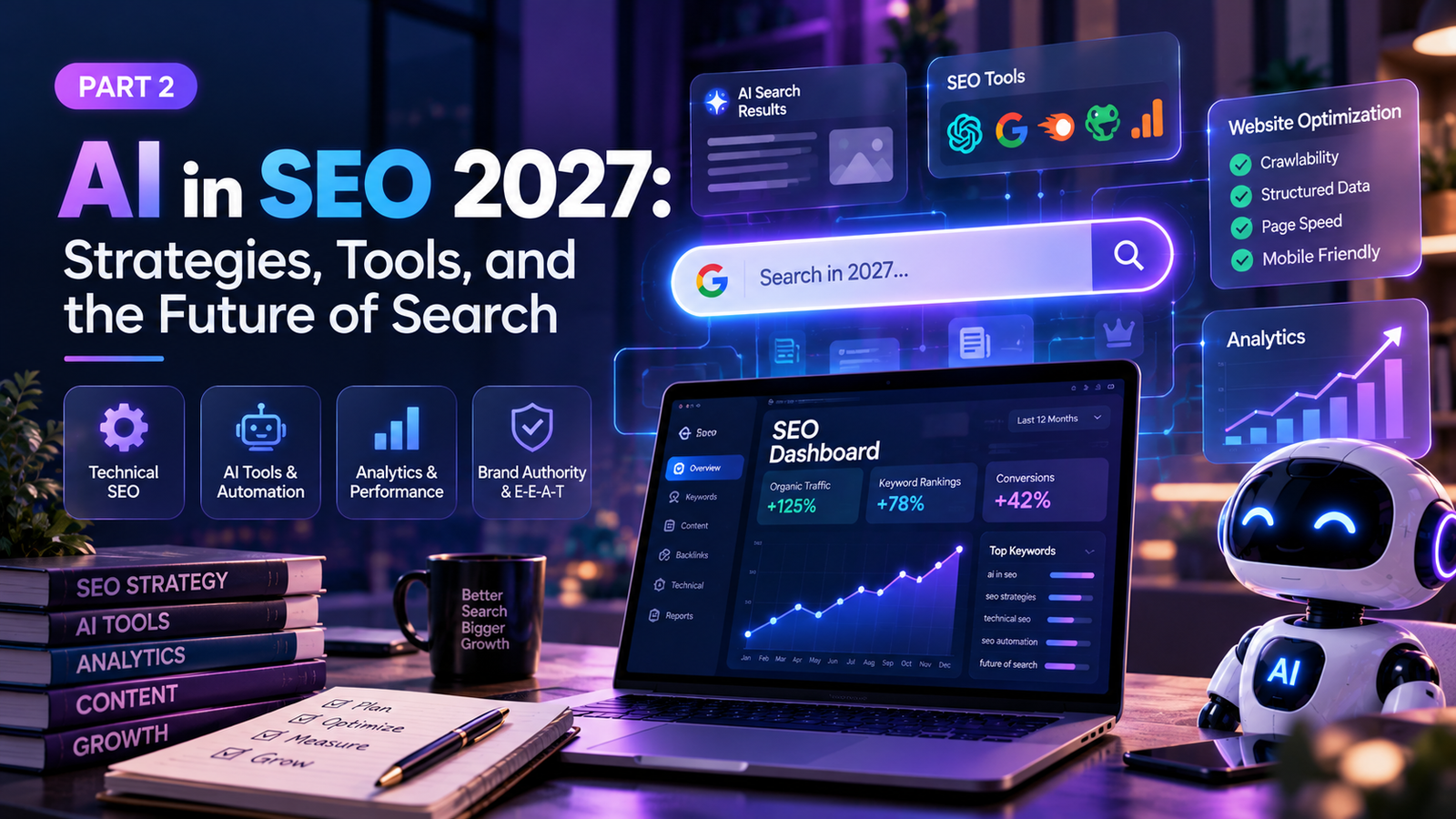
AI in SEO 2027: Strategies, Tools, and the Future of Search
Introduction
In Part 1, we explored how AI-powered search, Answer Engine Optimization (AEO), Generative Engine Optimization (GEO), and AI-assisted content creation are changing SEO.
But understanding these trends is only the first step. Businesses also need practical strategies to maintain search visibility, improve website performance, and turn organic discovery into measurable results.
As we approach 2027, SEO professionals must combine traditional optimization techniques with responsible AI adoption, technical expertise, and data-driven decision-making.
Let's explore the strategies businesses should prioritize.
1. Technical SEO in the AI Era
Technical SEO remains the foundation of a successful organic search strategy. Search engines need to discover, crawl, and index website pages before they can appear in traditional search results.
AI-powered search does not eliminate these requirements.
SEO professionals should regularly check:
Crawlability: Ensure search engines can access important pages.
Indexability: Identify pages that should be indexed but are not.
Website structure: Organize content logically with relevant internal links.
Page experience: Improve loading performance and mobile usability.
Structured data: Implement supported schema markup accurately.
Content accessibility: Keep important information available in readable text.
For example, an e-commerce website may publish excellent product descriptions, but incorrect canonical tags or blocked pages could prevent important product URLs from being indexed.
Tools such as Google Search Console and website crawlers can help identify and prioritize these issues.
Key takeaway: Build a technically accessible website before investing heavily in additional content or experimental AI optimization techniques.
2. AI Tools That Make SEO More Efficient
AI tools can help SEO professionals reduce repetitive work, organize information, and make faster decisions. However, tools should support an SEO strategy rather than determine it entirely.
Here are some useful applications:
Tool | Practical SEO application |
|---|---|
Content outlines, keyword clustering ideas, and content briefs | |
Google Search Console | Organic clicks, impressions, indexing, and search performance |
Google Analytics 4 | User behaviour, conversions, and traffic analysis |
Semrush | Keyword research, competitor analysis, and backlink research |
Screaming Frog SEO Spider | Technical website crawling and issue identification |
AI can also help summarize audit findings, compare content topics, and suggest opportunities for improvement.
For example, an SEO executive can use AI to organize a list of hundreds of keywords into topic groups, then validate the results using search data and manual SERP analysis.
Before publishing content or implementing technical changes, verify recommendations against reliable sources and the website's actual requirements.
Key takeaway: Use AI to save time on repetitive tasks while keeping strategy, validation, and final decisions under human control.
3. SEO Analytics: Measure What Actually Matters
SEO success should not be measured by rankings alone. A website may attract significant traffic without generating meaningful business results.
For example, a service business may receive thousands of informational visits but very few enquiries. Improving the visibility of relevant service pages could attract fewer visitors but produce more qualified leads.
A practical SEO dashboard should include:
Organic clicks and impressions.
Search visibility and keyword performance.
Qualified organic sessions.
Enquiries, leads, and purchases.
Conversion rate and organic revenue.
Referral traffic from AI platforms, where measurable.
Google Search Console helps measure search performance, while Google Analytics 4 helps analyze website behaviour and conversions. CRM data can connect those results to qualified leads and sales.
AI visibility can also be monitored by testing relevant queries across selected AI platforms. However, these observations may vary by platform, query, and time, so they should not be treated as a complete or standardized measurement of AI search performance.
Key takeaway: Connect SEO reporting to business objectives rather than focusing exclusively on traffic growth.
4. E-E-A-T and Brand Authority
E-E-A-T stands for Experience, Expertise, Authoritativeness, and Trustworthiness. Google's quality guidelines use these concepts to describe characteristics associated with high-quality content.
In an environment where AI makes content production easier, demonstrating genuine knowledge and credibility can help a business stand out.
Businesses can strengthen their authority by:
Publishing original research and practical case studies.
Providing accurate, useful information.
Showing clear authorship and relevant expertise.
Earning genuine backlinks and industry mentions.
Maintaining consistent and accurate business information.
For example, a digital marketing agency could publish a case study explaining its keyword research process, technical improvements, campaign results, and lessons learned.
This gives potential customers a concrete reason to trust the agency's expertise.
E-E-A-T is not a single score or a guaranteed ranking factor that can be increased through a checklist. It is a useful framework for evaluating content quality and credibility.
Key takeaway: Build authority through real expertise, useful information, and trustworthy online experiences.
5. Preparing Your SEO Strategy for 2027
Businesses do not need to abandon their existing SEO strategies to prepare for AI-driven search. Instead, they should strengthen the fundamentals and test new opportunities carefully.
Step 1: Audit your website
Review important pages for indexing problems, outdated content, broken links, and weak internal linking.
Step 2: Understand your audience
Identify customer questions, search intent, common problems, and the information people need before making a decision.
Step 3: Improve existing content
Update pages with missing information, stronger examples, accurate facts, and clearer explanations before creating unnecessary new articles.
Step 4: Experiment with AI search
Test how selected AI tools answer questions relevant to your industry. Review which sources are cited and whether your brand appears.
Step 5: Automate repetitive tasks
Use AI to assist with research, reporting, content briefs, and data organization while reviewing its output.
Step 6: Measure business impact
Track qualified leads, conversions, revenue, and search performance to understand which activities produce meaningful results.
These steps create a practical foundation for adapting to new search experiences without chasing every emerging trend.
6. The Future of SEO: What Comes Next?
The exact direction of SEO in 2027 remains uncertain, but several developments deserve attention.
More conversational search: Users may increasingly express complex needs through natural-language questions.
Broader brand discovery: Businesses may need to consider visibility across traditional search engines, AI assistants, video platforms, and relevant communities.
Smarter SEO workflows: AI may help professionals analyze data, identify content gaps, and automate routine reporting more efficiently.
Greater emphasis on original value: First-hand insights, useful research, credible examples, and accurate information can help distinguish a brand from generic content.
More comprehensive measurement: Marketers will need to connect search visibility with qualified traffic, leads, sales, and brand discovery wherever reliable measurement is possible.
These are strategic expectations, not guaranteed predictions. Businesses should monitor actual performance and adapt their plans as search technologies evolve.
Conclusion
The future of SEO is not simply about using more AI tools or optimizing for a new search feature. It is about combining technology with sound strategy, reliable data, and a clear understanding of customer needs.
As 2027 approaches, businesses should prioritize technical SEO, helpful content, brand credibility, responsible automation, and measurable business outcomes.
AI can make SEO workflows more efficient, but human expertise remains essential for interpreting results, validating recommendations, and making strategic decisions.
The strongest SEO strategy is one that adapts to changing search behaviour while continuing to deliver value to real people.
Frequently Asked Questions
1. Which AI tools are useful for SEO in 2027?
Tools such as ChatGPT, Google Search Console, Google Analytics 4, Semrush, and Screaming Frog can support different SEO activities, including research, performance analysis, competitor research, and technical audits.
2. Will technical SEO still matter in 2027?
Yes. Crawlability, indexability, site structure, mobile usability, and accessible content remain important foundations for search visibility.
3. How can businesses measure AI search visibility?
Businesses can test relevant queries across selected AI platforms, record brand mentions and citations, and monitor available referral traffic. Results should be interpreted cautiously because reporting methods and platform behaviour vary.
4. How can AI improve SEO productivity?
AI can assist with keyword clustering, content briefs, data summaries, audit prioritization, and reporting. Human review remains important for accuracy and strategic relevance.
5. What should businesses prioritize first?
Start with technical SEO, audience research, content quality, and reliable performance measurement. Once these foundations are in place, test AI search visibility and automation opportunities that support business goals.