MQL vs SQL for Education Leads: Do Institutes Need Both?

MQL vs SQL for Education Leads: Do Institutes Need Both?
Introduction
Coaching institutes receive student enquiries through websites, Instagram, Google Ads, WhatsApp, referrals, and other marketing channels. However, not every student who submits an enquiry is ready to enrol immediately.
Some students are still exploring courses, comparing institutes, or researching career options. Others already know what they want and are ready to discuss fees, batch timings, counselling, or admission.
Treating every enquiry in the same way can make it difficult for admissions teams to prioritise their work. This is where Marketing Qualified Leads (MQLs) and Sales Qualified Leads (SQLs) become useful.
Understanding the difference between MQLs and SQLs helps coaching institutes organise student enquiries, deliver relevant information, and identify when a prospective student is ready for a direct admission conversation.
In this guide, we will explain what MQLs and SQLs mean, how they work in education marketing, and whether your institute needs both.
What Is an MQL (Marketing Qualified Lead)?
A Marketing Qualified Lead, or MQL, is a prospective student who has shown meaningful interest in an institute or its courses through marketing activities but may not yet be ready for a direct admission conversation.
For example, a student might visit the institute's website, download a course brochure, attend an online webinar, or engage with educational content on social media.
These actions suggest interest, but they do not automatically mean the student is ready to enrol.
Examples of MQLs for Coaching Institutes
A student may be considered an MQL when they:
Download a digital marketing course brochure.
Register for a free introductory webinar.
Submit a website enquiry asking for general course information.
Repeatedly engage with educational content.
Subscribe to receive course updates.
The institute should define its own qualification criteria based on the student's course interest, engagement, and the information provided.
What should happen next?
The marketing team can nurture the student's interest by sharing relevant course details, educational resources, upcoming workshops, or answers to common questions. Communication should respect the student's preferences and consent.
What Is an SQL (Sales Qualified Lead)?
A Sales Qualified Lead, or SQL, is a prospective student who has been reviewed and appears ready for a direct conversation with the admissions or counselling team.
Unlike an MQL, an SQL demonstrates a stronger indication of admission intent.
For example, a student may ask about the next batch, confirm the course fee, request a counselling appointment, or explain that they want to begin a programme soon.
These signals help the admissions team decide when a personalised conversation would be useful.
Examples of SQLs for Coaching Institutes
A student may qualify as an SQL when they:
Request a counselling session about a specific course.
Ask about available batches and admission dates.
Discuss course fees and payment options.
Confirm that the course matches their learning goals.
Ask for the steps required to complete enrolment.
An enquiry alone does not always make someone an SQL. The institute should review the student's needs and readiness before assigning this status.
What should happen next?
The admissions team can contact the student, answer questions, explain the admission process, and record the next action in the CRM.
For more background, read HubSpot's guide to sales-qualified leads.
MQL vs SQL: What Is the Difference?
Both MQLs and SQLs represent prospective students, but they reflect different levels of readiness.
Factor | MQL | SQL |
|---|---|---|
Meaning | Marketing Qualified Lead | Sales Qualified Lead |
Main signal | Relevant interest and engagement | Readiness for a direct admission conversation |
Typical example | Downloads a course brochure | Requests a counselling appointment |
Main team | Marketing | Admissions or counselling |
Recommended action | Share useful information and nurture interest | Discuss course fit and admission next steps |
Main objective | Build understanding and interest | Determine suitability and support an informed decision |
The distinction is not about labelling one student as more valuable than another. It helps the institute provide the right information at the right stage of the student's decision-making journey.
Why Do Coaching Institutes Need Both MQLs and SQLs?
For many institutes, using both categories can create a more organised process, especially when the team receives a high volume of enquiries.
1. Better Lead Prioritisation
Admissions counsellors may not have enough time to conduct immediate, detailed conversations with every person who interacts with a social media post or downloads a brochure.
Identifying MQLs and SQLs helps the team prioritise direct conversations with students who have demonstrated stronger intent, while continuing to support those who are still researching.
2. More Relevant Communication
A student who is exploring career options may need educational content explaining course benefits and career pathways.
A student who has requested a counselling session may instead need information about the syllabus, schedule, eligibility, fees, and admission process.
Separating the stages helps institutes respond more appropriately.
3. Better Coordination Between Marketing and Admissions
Marketing teams often focus on generating enquiries, while admissions teams focus on counselling and enrolment.
Without shared definitions, marketing may consider an enquiry successful even when the admissions team cannot establish the student's needs or interest.
Agreeing on MQL and SQL criteria creates a clearer handover between the teams.
4. More Useful Marketing Reports
Tracking MQLs and SQLs helps an institute look beyond the total number of enquiries.
For example, a campaign may generate many brochure downloads but few counselling bookings. Another campaign may generate fewer enquiries but attract students who are more prepared to discuss admission.
Both outcomes are useful information for improving the marketing strategy.
How to Build a Simple MQL-to-SQL Process
A coaching institute does not need a complicated system to begin. A clearly defined workflow and a consistent enquiry tracker are often enough for a small team.
Step 1: Capture Student Enquiries
Collect essential information through your website enquiry form, social media campaigns, workshops, or other channels.
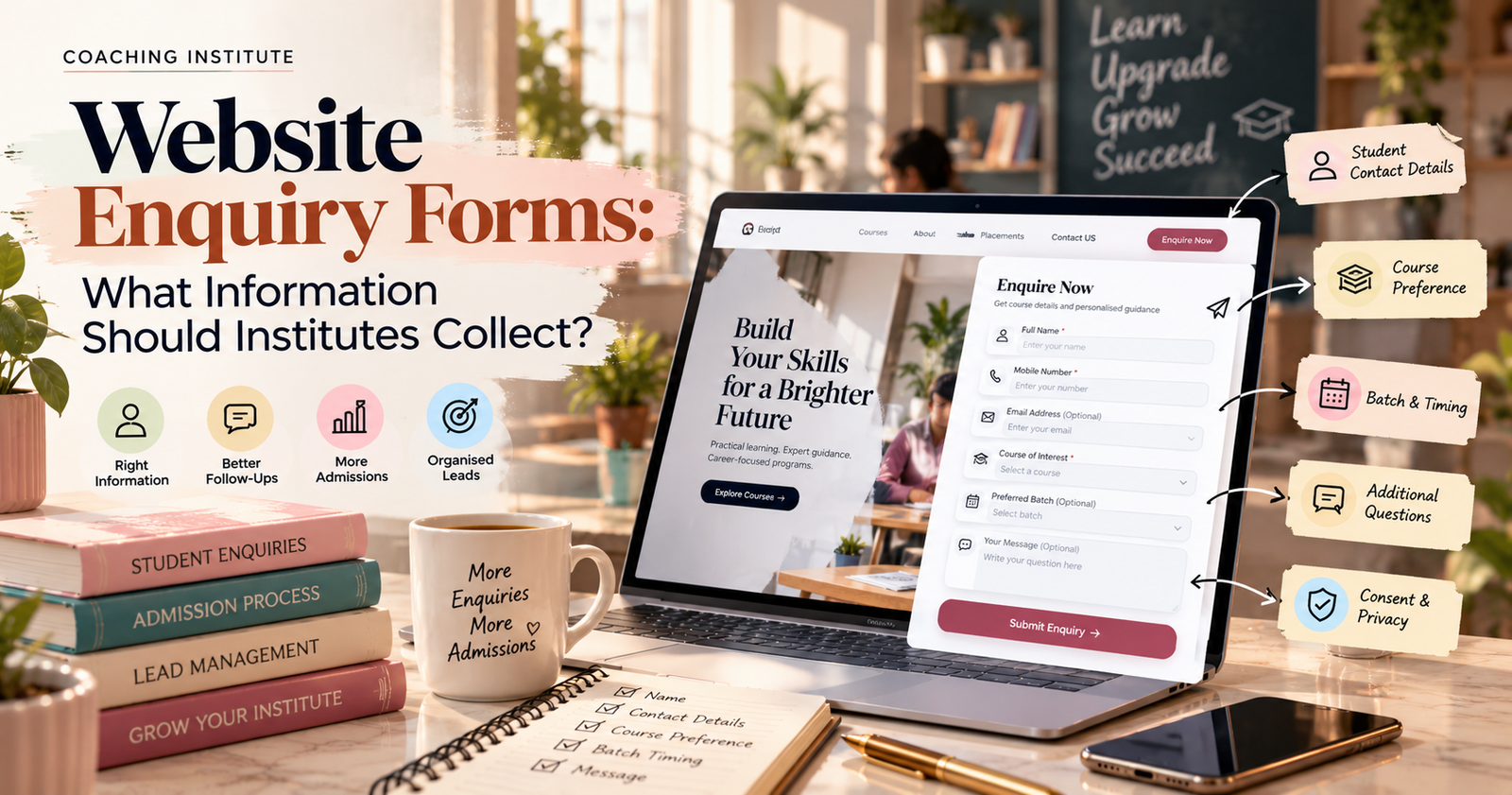
A well-designed form might ask for the student's name, preferred contact method, course of interest, and relevant questions.
Avoid collecting unnecessary personal information.
Step 2: Define Your MQL Criteria
Decide which signals indicate that a student has enough relevant interest to be treated as an MQL.
For example, your criteria might include a relevant course enquiry, a completed brochure request, or attendance at an introductory session.
Do not rely on a single low-intent action, such as a social media like, as proof of admission readiness.
Step 3: Nurture MQLs
Provide useful information that helps prospective students make an informed decision.
Depending on their interests, this may include course guides, curriculum details, educational blog posts, webinar invitations, or answers to frequently asked questions.
For instance, a student exploring digital marketing could be directed to TroopyStack's blog collection to discover relevant educational articles and further reading.
Use relevant resources rather than sending repetitive promotional messages.
Step 4: Identify SQLs
When a student demonstrates clear interest in discussing admission, the team should review the enquiry and decide whether it meets the institute's SQL criteria.
Signals may include a request for counselling, questions about an upcoming batch, or a request for specific admission information.
Record the reason for the qualification so that the process remains consistent.
Step 5: Assign the Lead to a Counsellor
Once an enquiry meets the SQL criteria, assign it to the appropriate admissions counsellor.
The counsellor should be able to see the student's course interest, previous interactions, questions, and agreed next step.
Step 6: Track the Outcome
Update the record after the conversation. The student might proceed towards enrolment, need more time, request further information, or decide not to continue.
Not every SQL becomes an enrolled student. The purpose of qualification is to improve the process, not to guarantee an admission.
How Can a CRM Help Manage MQLs and SQLs?
A Customer Relationship Management (CRM) system can help coaching institutes store enquiry details, track lead stages, assign tasks, and record communication.
For a small institute, a spreadsheet may be sufficient initially. A growing admissions team may benefit from a dedicated CRM platform such as HubSpot.
A simple CRM pipeline could look like this:
New Enquiry → MQL → Counselling or Qualification → SQL → Admission Follow-Up → Enrolled or Closed
The exact stages should reflect the institute's real process. Some teams may also use an intermediate review stage before accepting an MQL into the admissions pipeline.
Useful CRM fields include:
Student name and contact details.
Course of interest.
Enquiry source.
Current lead stage.
Assigned counsellor.
Last contact date.
Next follow-up date.
Qualification notes and outcome.
Keeping these records accurate makes it easier for marketing and admissions teams to work together.
Which Metrics Should Institutes Track?
To understand whether the process is effective, track a few practical metrics.
MQL volume: The number of leads that meet the institute's marketing qualification criteria.
MQL-to-SQL conversion rate: The percentage of MQLs that become SQLs during a defined period or cohort.
Counselling booking rate: The percentage of relevant enquiries that result in booked counselling sessions.
SQL-to-admission conversion rate: The percentage of SQLs that become confirmed admissions.
Follow-up completion: The percentage of scheduled follow-up tasks completed on time.
For example, if an institute identifies 100 MQLs and 25 later qualify as SQLs, the MQL-to-SQL conversion rate for that group is 25%.
This is an illustrative example, not an industry benchmark. Institutes should compare their own results over time and consider differences between courses, campaigns, and enquiry sources.
Where website tracking is configured appropriately, Google Analytics can help analyse website traffic and relevant conversion events. CRM records are still important for understanding counselling outcomes and confirmed admissions.
Common Mistakes to Avoid
Treating Every Enquiry as an SQL
A person who downloads a brochure may simply be researching. Review their actual intent before assigning them to the SQL stage.
Using Unclear Qualification Criteria
Marketing and admissions teams should agree on what qualifies as an MQL and an SQL. Otherwise, the same enquiry may be classified differently by different staff members.
Ignoring MQLs Who Need More Time
Students may take time to compare courses or discuss options with their families. Provide useful information and respect their preferred communication frequency.
Focusing Only on Lead Volume
A large number of enquiries does not necessarily mean a successful campaign. Evaluate lead quality, counselling engagement, admissions, and the cost of acquiring students.
Failing to Update the CRM
If lead statuses and follow-up notes are outdated, the team cannot rely on the pipeline to guide its next actions.
Conclusion: Do Institutes Need Both MQLs and SQLs?
For coaching institutes that manage enquiries across multiple channels or have separate marketing and admissions responsibilities, using both MQLs and SQLs can create a clearer, more organised process.
MQLs help identify prospective students who have shown relevant interest and may benefit from further information. SQLs help identify those who are ready for a more direct conversation with the admissions team.
The most important step is to define both categories clearly, document the handover process, and review results regularly.
Start with a simple lead tracker, agree on qualification criteria, and use the data to improve communication and follow-up over time.
The key takeaway: MQLs help institutes nurture interest, while SQLs help admissions teams focus on students who are ready for a direct conversation. Together, they can support a more structured student admission journey.