Best AI Tools for Digital Marketers in 2026: A Complete Guide
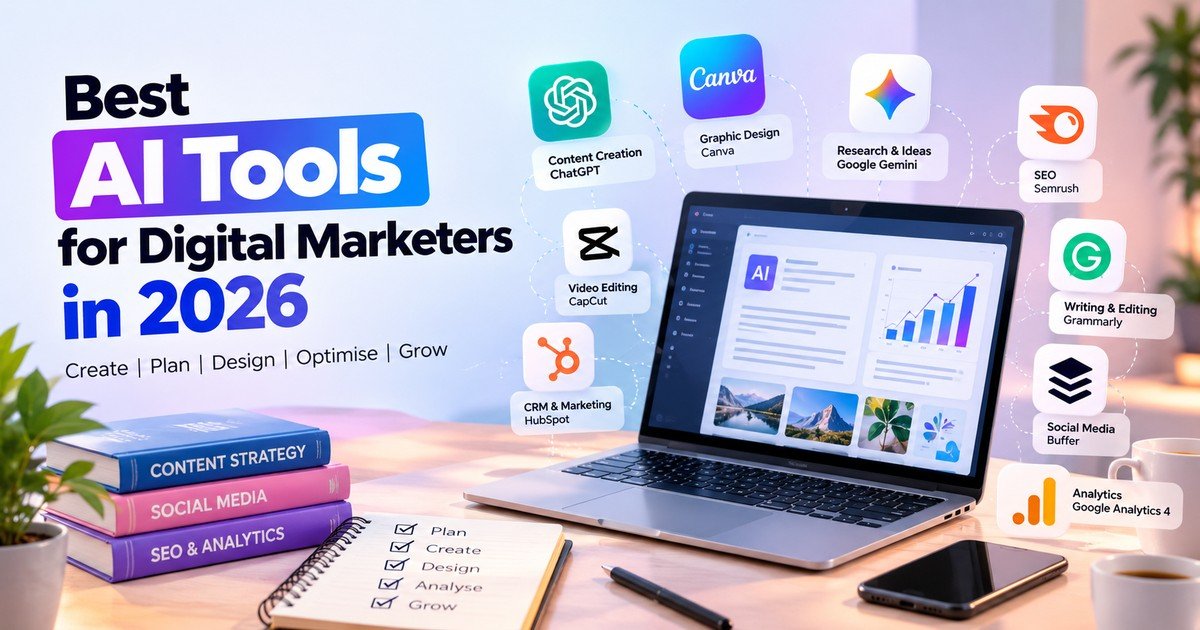
Best AI Tools for Digital Marketers in 2026: A Complete Guide
Introduction
Digital marketing is evolving rapidly, and artificial intelligence (AI) is becoming an important part of how businesses create content, manage social media, improve search visibility, and understand their audiences.
From generating blog ideas to designing social media posts and analysing campaign performance, AI tools can help marketers save time and organise their work more efficiently. However, choosing the right tools is essential. Using too many platforms can create unnecessary complexity and expenses.
In this guide, we will explore some of the best AI tools for digital marketers in 2026, their key features, and how beginners and businesses can use them to improve their marketing strategies.
1. ChatGPT — Best for Content Ideas and Marketing Strategy
ChatGPT is an AI assistant that can help digital marketers brainstorm ideas, draft content, organise campaigns, and develop marketing strategies.
How marketers can use it:
Generate blog topics and content calendars.
Write first drafts of captions, emails, and blog posts.
Brainstorm advertising concepts and campaign ideas.
Create audience personas and customer journey outlines.
Repurpose long-form content into shorter social media posts.
Example: A digital marketer managing a skincare brand can use ChatGPT to brainstorm a month's worth of Instagram content, including educational posts, product highlights, and frequently asked questions.
Website: https://chatgpt.com/
2. Canva Magic Studio — Best for Graphic Design
Visual content plays a major role in digital marketing. Canva provides design templates and AI-assisted features that help marketers create professional-looking visual assets.
How marketers can use it:
Design Instagram posts, stories, and carousels.
Create presentations, brochures, and marketing banners.
Generate and edit visual content using available AI features.
Maintain consistent brand colours, fonts, and layouts.
Resize designs for different platforms.
Example: A small business can create a coordinated set of Instagram posts and promotional banners without building every design from scratch.
Website: https://www.canva.com/
3. Google Gemini — Best for Research and Brainstorming
Google Gemini can assist with research, idea generation, summarisation, and planning. Depending on the available features and settings, it can also support workflows across compatible Google products.
How marketers can use it:
Brainstorm marketing campaign themes.
Organise research into clear summaries.
Generate outlines for blogs and presentations.
Explore different approaches to a marketing problem.
Draft and refine content ideas.
Example: Before launching a new product, a marketer can use an AI assistant to organise audience research questions and develop a preliminary campaign outline. Important market claims should still be verified using reliable sources.
Website: https://gemini.google.com/
4. Semrush — Best for SEO Research
Search engine optimisation helps websites become more discoverable through search engines. Semrush offers SEO and digital marketing tools that support keyword research, competitor analysis, site audits, and content planning.
How marketers can use it:
Research relevant search terms.
Explore competitor website visibility.
Identify potential technical SEO issues.
Track keyword rankings.
Find opportunities to improve website content.
Example: A digital marketing blog targeting readers in Ahmedabad could research relevant local search terms and use the findings to plan useful, location-specific articles.
Website: https://www.semrush.com/
Tip: Keyword tools provide estimates and opportunities, not guarantees of ranking or traffic.
5. Grammarly — Best for Writing and Editing
Clear, professional communication is essential for blogs, emails, advertisements, and social media captions. Grammarly helps writers review grammar, clarity, tone, and readability, with AI-assisted writing features available in supported plans.
How marketers can use it:
Correct grammar and spelling.
Improve sentence clarity.
Adjust the tone of professional messages.
Review blog drafts before publishing.
Make marketing copy easier to read.
Example: After drafting a blog about social media marketing, a writer can use Grammarly to identify awkward sentences and improve readability before publication.
Website: https://www.grammarly.com/
6. HubSpot — Best for CRM and Marketing Workflows
HubSpot offers customer relationship management (CRM) and marketing tools that help businesses organise contacts, manage leads, and coordinate customer communications. Its AI capabilities vary by product and subscription.
How marketers can use it:
Organise customer and lead information.
Manage marketing campaigns and follow-ups.
Create and manage email marketing workflows.
Track interactions across the customer journey.
Review marketing and sales performance.
Example: A business can organise incoming enquiries and create a structured follow-up process so that potential customers receive timely responses.
Website: https://www.hubspot.com/
7. CapCut — Best for Short-Form Video Editing
Short-form video is an important content format for many brands and creators. CapCut provides video-editing tools, with AI-assisted capabilities available depending on the version and region.
How marketers can use it:
Edit Instagram Reels and YouTube Shorts.
Add captions and transitions.
Improve pacing and arrange video clips.
Create product demonstrations.
Adapt videos to different social platforms.
Example: A hardware brand can turn product footage into a short Reel showing product features, practical applications, and a clear call to action.
Website: https://www.capcut.com/
8. Buffer — Best for Social Media Planning
Planning and publishing content consistently can be challenging when managing several social media accounts. Buffer supports social media scheduling and offers writing assistance and other features depending on its current plans.
How marketers can use it:
Plan upcoming social media posts.
Schedule supported content.
Organise publishing calendars.
Draft and refine post captions.
Review available engagement and performance metrics.
Example: A small business can plan a weekly content schedule covering educational posts, product showcases, customer questions, and promotional content.
Website: https://buffer.com/
9. Google Analytics 4 — Best for Website Performance Analysis
Google Analytics 4 (GA4) helps marketers understand how visitors interact with a website or app. Its reporting and insights can support decisions about content, acquisition channels, and user behaviour.
How marketers can use it:
Measure website traffic and engagement.
Explore where visitors come from.
Analyse important user actions and conversions.
Compare performance across acquisition channels.
Identify pages that may need improvement.
Example: If a blog receives visitors but few people click through to its service page, a marketer can investigate the user journey and improve relevant links or calls to action.
Website: https://analytics.google.com/
10. Jasper — Best for Brand-Focused Marketing Content
Jasper is an AI content platform designed for marketing workflows. It can help teams develop and adapt content while working towards a consistent brand voice.
How marketers can use it:
Draft marketing copy and campaign assets.
Adapt messaging for different channels.
Develop content variations for testing.
Support brand voice consistency.
Organise repeatable content workflows.
Example: A marketing team can prepare different versions of an advertising message for social media, email, and a landing page while keeping the central brand message consistent.
Website: https://www.jasper.ai/
How to Choose the Right AI Tools for Digital Marketing
Not every marketer needs every tool. The best combination depends on your goals, budget, experience, and workflow.
Here is a simple comparison:
Marketing task | Tool to explore |
|---|---|
Content ideas and first drafts | ChatGPT |
Graphic design and social posts | Canva |
Research and brainstorming | Google Gemini |
Keyword research and SEO | Semrush |
Grammar and readability | Grammarly |
CRM and marketing workflows | HubSpot |
Short-form video editing | CapCut |
Social media scheduling | Buffer |
Website analytics | Google Analytics 4 |
Brand-focused marketing content | Jasper |
Before subscribing to a paid service, check its official website for current features, usage limits, and pricing. Free access and AI allowances may differ by tool and region.
How Beginners Can Use AI Tools Effectively
If you are starting your digital marketing journey, you do not need a large collection of software. Begin with a few tools that address your most frequent tasks.
Step 1: Plan your content
Use an AI assistant to brainstorm topics, define your target audience, and create a draft content calendar.
Step 2: Create your visuals
Use a design platform to produce social media graphics that match the brand's colours, typography, and style.
Step 3: Optimise your content
Use SEO research tools to understand search intent, identify relevant keywords, and improve your content structure.
Step 4: Publish consistently
Use a social media scheduling tool if it fits your workflow and the platforms you manage.
Step 5: Measure performance
Review available analytics to understand what audiences respond to and which content needs improvement.
Step 6: Review everything before publishing
Check facts, spelling, brand tone, copyright considerations, and the accuracy of AI-generated content. Avoid uploading confidential customer or business information to AI services unless you have appropriate permission and have reviewed the service's privacy settings.
Benefits and Limitations of AI in Digital Marketing
AI can help marketers work more efficiently, generate ideas, and handle repetitive tasks. It can also support content planning and data analysis.
However, AI-generated material may contain incorrect information, generic recommendations, or messaging that does not suit a particular audience. It cannot replace every aspect of human judgement, creativity, customer understanding, or strategic decision-making.
The strongest approach is to combine AI assistance with human review, original ideas, reliable research, and real performance data.
Conclusion
AI tools are becoming valuable resources for digital marketers in 2026. From ChatGPT and Canva to Semrush, Buffer, and Google Analytics 4, different platforms can support different stages of the marketing process.
The goal is not to use the greatest number of AI tools. It is to select the right tools for your needs and use them thoughtfully.
For beginners, starting with content creation, graphic design, SEO research, and analytics is a practical way to build digital marketing skills. As your experience grows, you can introduce more specialised tools based on the projects you manage.
Remember: AI can help you work faster, but thoughtful strategy, original creativity, accuracy, and a clear understanding of your audience are what make marketing effective.